When you buy through links on our articles, Future and its syndication partners may earn a commission.

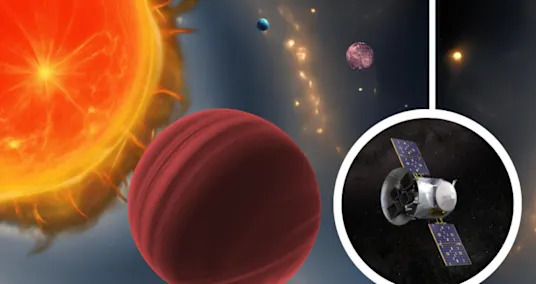
Astronomers have discovered over 100 new worlds beyond the solar system hiding in data collected by NASA's exoplanet-hunting spacecraft TESS (Transiting Exoplanet Survey Satellite), and it's thanks to artificial intelligence. The technique also identified a further 2,000 or so candidate extrasolar planets, or exoplanets, around half of which were hitherto undetected.
Considering that there are around 6,000 exoplanets currently in NASA's exoplanet catalog, confirming those candidate worlds would represent a major boost in our hunt for planets around other stars. The innovative new AI program behind this discovery is called RAVEN, and was developed by researchers at the University of Warwick in the U.K.
TESS spots exoplanets by recording the tiny dips in starlight they cause when they pass in front of the face of the parent star, a passage called a "transit." RAVEN studied TESS observations of over 2.2 million stars collected during the NASA spacecraft's first four years, hunting for planets so close to their home stars that they complete an orbit in just 16 Earth days. The AI pipeline could therefore help to confirm how common these tight-orbit planets are and the kind of systems in which they are most often found.
"This represents one of the best characterized samples of close-in planets and will help us identify the most promising systems for future study," team leader Marina Lafarga Magro of the University of Warwick said in a statement.
RAVEN's eagle eye is scanning the Neptunian desert
Since the first exoplanets were discovered in the mid-1990s, the exoplanet catalog has burgeoned to over 6,000 confirmed entries, but thousands of candidates identified by exoplanet-hunting space missions like TESS, Kepler and CHEOPS (Characterizing Exoplanet Satellite) remain unconfirmed.
That is because scientists need to determine whether small dips in starlight are actually caused by transiting exoplanets or if they have another, non-planetary cause. This means making these confirmations more rapidly and confidently is a major challenge that astronomers are eager to ease.
"The challenge lies in identifying if the dimming is indeed caused by a planet in orbit around the star or by something else, like eclipsing binary stars, which is what RAVEN tries to answer," RAVEN head developer Andreas Hadjigeorghiou of the University of Warwick said in the statement. "Its strength stems from our carefully created dataset of hundreds of thousands of realistically simulated planets and other astrophysical events that can masquerade as planets."
Hadjigeorghiou developer explained that the team trained machine learning models to identify patterns in the data that can tell astronomers the type of event that has been detected, something that AI models excel at. RAVEN is designed to handle the whole exoplanet-detection process in one go — from detecting the signal to vetting it with machine learning and then statistically validating it. That means that it has an additional edge over other contemporary tools that only focus on specific parts of this process, Hadjigeorghiou said.

"RAVEN allows us to analyze enormous datasets consistently and objectively," senior team member and University of Warwick researcher David Armstrong said in the statement. "Because the pipeline is well-tested and carefully validated, this is not just a list of potential planets — it is also reliable enough to use as a sample to map the prevalence of distinct types of planets around sun-like stars."
Within the candidate close-in planets, researchers could then determine the types of planets and their populations in detail. This revealed that around 10% of stars like the sun host a close-in planet, validating findings made by TESS's exoplanet-hunting predecessor Kepler.
RAVEN was also able to help researchers determine just how rare close-in Neptune-size worlds are, finding that they occur around just 0.08% of sun-like stars. This absence of these worlds close to their parent star is referred to as the "Neptunian desert" by astronomers.
"For the first time, we can put a precise number on just how empty this 'desert' is," leader of the Neptunian desert study team, Kaiming Cui of the University of Warwick said in the statement. "These measurements show that TESS can now match, and in some cases surpass, Kepler for studying planetary populations."
The RAVEN results demonstrate the power of AI to search through vast swathes of astronomical data to spot subtle effects.
The team's research was published across three papers in the journal Monthly Notices of the Royal Astronomical Society and is also available on the paper repository site arXiv.
NEUESTE BEITRÄGE
- 1
 Help Your Insusceptibility: Good dieting and Way of life Tips01.01.1
 - 2Nine in 10 German industrial firms expect Iran war to hit business31.03.2026
- 3Paris Agreement target off the table, report says07.04.2026
- 4How to watch 'Tell Me Lies' Season 3: Episode release times, streaming info and more13.01.2026
- 5How AI fixed the James Webb Space Telescope's blurry vision05.11.2025





Ähnliche Artikel
- Arrow Exploration brings new Colombian oil well on stream ahead of schedule and under budget01.04.2026
- Opening Potential: Self-awareness and Long lasting Learning06.06.2024
- Voting begins in Uganda’s presidential election during internet shutdown and polling station delays14.01.2026
- CDC pauses dozens of types of lab testing during evaluation and in wake of downsizing01.04.2026
- AfD in Brandenburg takes back suit against the intelligence service02.01.2026
- Explainer-What Novo Nordisk's weight-loss pill approval means for company, patients23.12.2025
- 8 key takeaways from Savannah Guthrie's 'Today' interview on the disappearance of her mother26.03.2026
- Melodic Event: A Survey of \Energies and Exhibitions Assessed\ Live concert10.08.2023
- Gov’t approves millions for border cities in North under Hezbollah fire25.03.2026
- Early diagnosis leads King Charles to scale back cancer treatment in the new year12.12.2025