When you buy through links on our articles, Future and its syndication partners may earn a commission.

For the first time in more than 50 years, humans are cruising through lunar space.
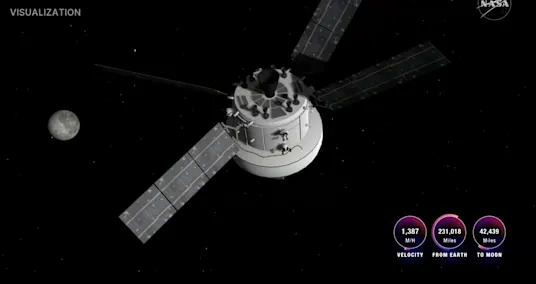
The four astronauts of NASA's Artemis 2 mission arrived in the moon's sphere of influence — the region where lunar gravity exerts a more powerful pull than that of Earth — today (April 6) at 12:37 a.m. EDT (0437 GMT).
The milestone occurred when the mission's Orion capsule was about 39,000 miles (62,764 kilometers) from the moon and roughly 232,000 miles (373,368 km) from Earth, a commentator said during NASA's Artemis 2 livestream.
The Artemis 2 astronauts — NASA's Reid Wiseman, Victor Glover and Christina Koch and the Canadian Space Agency's Jeremy Hansen — are the first people to cross the lunar threshold since December 1972, when the three-person Apollo 17 moon-landing mission did so.
Artemis 2 will not touch down on the moon, or even enter lunar orbit. Rather, Orion will loop around the moon's far side this evening in a history-making flyby. During that encounter, Artemis 2 will get farther from Earth than any crewed flight ever has.
The distance record is currently held by the Apollo 13 astronauts, who got 248,655 miles (400,171 km) from our planet in April 1970. At the height of tonight's flyby, just after 7 p.m. EDT (2300 GMT), Artemis 2 will be 252,757 miles (406,773 km) away from the rest of humanity, NASA officials have said.
The Artemis 2 astronauts will study the moon during the flyby, gathering data that could help scientists better understand the terrain and geology of Earth's nearest neighbor. They'll also be treated to a total solar eclipse, which will not be visible to those of us here on terra firma.
In addition, the flyby will chart their path home: Lunar gravity will slingshot Orion back toward Earth. Artemis 2 astronauts will come home on Friday (April 10), ending their 10-day mission with a parachute-aided splashdown off the coast of San Diego.
Editor's note: This story was updated at 1:15 a.m. EDT on April 6 with NASA's revised time of Orion's entry into the moon's sphere of influence — 12:37 a.m. EDT rather than 12:41 a.m. EDT.
NEUESTE BEITRÄGE
- 1
 What were the little white pills found in Tiger Woods's pocket at the scene of his crash? What to know about hydrocodone.31.03.2026
 - 2Top Music and Dance Celebration: Which One Gets You Going?01.01.1
- 3Whale stranded in the Baltic Sea swims free again. It still faces a tough task31.03.2026
- 4Internet goes (cocoa) nuts: The funniest reactions to 12 tonne theft of KitKat bars30.03.2026
- 5Tributes pour in for MIT professor Nuno Loureiro amid unresolved shooting case18.12.2025





Ähnliche Artikel
- Young Muslims in Germany feel left out of Mideast debate, experts say26.11.2025
- Avoid Slam: Exploring the Pickup Truck Transformation06.11.2023
- Careful Living: Embracing the Current Second01.01.1
- New movies to watch this weekend: See 'We Bury the Dead' in theaters, rent 'Wicked: For Good,' stream 'The Unbreakable Boy' on Starz02.01.2026
- Geminid meteor shower, one of the year's most reliable, peaks this weekend13.12.2025
- This Flashy Old-School Design Trend From Italy Still Has A Place In Modern Kitchens14.11.2025
- Miss 'Stranger Things' already? Here's how you can get your Upside Down fix in 2026 with spinoffs, games and more02.01.2026
- Lahav 433 head Asst.-Ch. Meni Benjamin named as police officer investigated for breach of trust13.11.2025
- The most effective method to Consummate the Specialty of Handshaking in Business and Group environments19.10.2023
- Is Chinese food truly flavorful?05.06.2024


