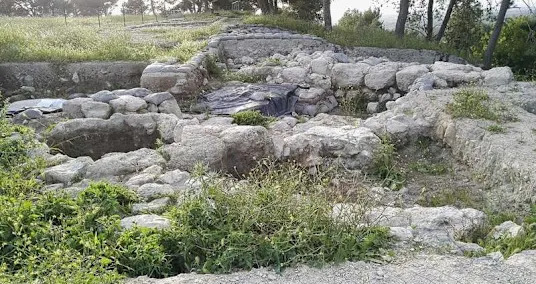
Simply made pottery jars, beads, copper jewelry, and stone and mortar hammers were discovered within the cistern alongside the remains.
A mass grave of children was discovered within an abandoned water cistern during archaeological excavations at Tel Azekah, according to a recent study published in the Palestine Exploration Quarterly.
Tel Azekah, located near Beit Shemesh, is the site of the famed biblical fight between David and Goliath.
The remains of between 68 to 89 individuals were discovered during excavations in 2012-2013 within a water cistern repurposed for the burial, and have been dated to the Persian period (5th century BCE), offering a rare glimpse into how societies at the time treated their young after death.
Studying the bones, researchers found that the majority of the remains found belonged to children under the age of five, while 70% of the remains belonged to toddlers less than two years old. Only a few individuals were identified to have been teenagers or adults.
The varied demographic further suggested to researchers that the mass burial in the cistern had been intentional rather than simply a result of a single disaster like an epidemic or famine, modeled after the Iron Age practice of entombing family members together.

Additionally, the remains were largely found in their original positions, indicating that the cistern was the primary place of burial and not moved there from an earlier grave.
Simply made pottery jars, beads, copper jewelry, and stone and mortar hammers were discovered within the cistern alongside the remains.
Infants buried in cistern not considered part of society
A theory proposed by the researchers is that the cistern served as a mass burial site for infants who had not yet transitioned from being breast fed to eating solid foods.
Those who died before the transition “were not granted individual interments since they were not yet weaned,” the study explained, as they had not yet achieved full social status, contrasting sharply with adult burials from the same period which were usually individual.
Further, the study noted that no signs of trauma, burning, or cuts were identified on the remains, ruling out the possibility of ritual sacrifice or infanticide and instead suggesting that the mass burial was an accepted mortuary practice formed in a society with a high infant mortality rate.
The cistern at Tel Azekah provides rare archaeological confirmation that social identity at the time only began after early childhood, a discovery that allows researchers to expand on the “limited understanding of infant and young children’s burial practice” at the time.
NEUESTE BEITRÄGE
- 1
 More charges filed against ex-left-wing RAF member Daniela Klette27.03.2026
 - 26 Exercises to Anticipate in 202406.06.2024
- 3Eurasian cargo hub expands to capture Europe-Asia freight flows03.04.2026
- 4Former hostage Eitan Mor on Hamas: ‘They will not give up until the last Israeli is gone'12.01.2026
- 5British-Egyptian dissident apologises for tweets as Tories push for UK deportation29.12.2025





Ähnliche Artikel
- Heart disease risk greater for women with a common condition they may not be aware they have10.12.2025
- Iran slams UN nuclear watchdog for failing to condemn Bushehr attacks06.04.2026
- Poland Crypto Bill Clears Sejm Again, Defying President — Will “Restrictive” Rules Stick?19.12.2025
- Monetary Versatility: Get ready for Life's Unforeseen Difficulties01.01.1
- Record-breaking 'space laser' erupts from merging galaxies 8 billion light-years away30.03.2026
- Shrewd Home Gadgets to Save Energy06.06.2024
- Phonetic Associations: A Survey of \Interfacing Worldwide People group\ Language Trade Application10.08.2023
- Step by step instructions to Guarantee the Strength and Life span of Your Pre-assembled Home19.10.2023
- Melodic Event: A Survey of \Energies and Exhibitions Assessed\ Live concert10.08.2023
- Instructions to Warmly greet Discretion and Thoughtfulness19.10.2023