By Lucila Sigal
BUENOS AIRES, April 1 (Reuters) - An Argentine-built microsatellite, the only one from Latin America selected for NASA's return to the moon, will test experimental navigation systems and measure radiation far beyond Earth's orbit when it flies on the Artemis II mission.
The shoebox-sized satellite, known as ATENEA, is one of four international payloads chosen by NASA from proposals submitted by nearly 50 countries to accompany Artemis II, the first crewed lunar mission in more than half a century, which was scheduled to lift off later on Wednesday. The others are from Germany, Saudi Arabia and South Korea.
Developed by the engineering faculty at the University of Buenos Aires, with support from Argentina's national space agency CONAE and other scientific institutions, ATENEA will travel roughly 72,000 kilometers (44,739 miles) from Earth, well beyond the planet's protective magnetic field.
Argentina's project director Fernando Filippetti said the mission offers a rare chance for Argentine scientists to study conditions in deep space, where radiation levels are far higher and more volatile than in low-Earth orbit.
"Even though Argentina is better known for football, our space agency CONAE has built satellites of extremely high complexity, of world-class standard," Filippetti said, speaking by phone from Cape Canaveral, Florida.
The satellite will focus on measuring radiation exposure and test whether faint signals from Earth's GPS satellites can be harnessed to navigate far from the planet.
"This represents a unique opportunity to test and measure parameters in deep space," Filippetti said.
ATENEA will attempt to capture data with the aim of laying the groundwork for a future space-based GPS capable of determining a spacecraft's position far from Earth.
Argentina's space sector had quietly developed technology of global standard, despite limited resources, Filippetti said.
Libertarian President Javier Milei's government has sharply cut public spending since taking office in late 2023, with funding reductions hitting many state institutions, including CONAE.
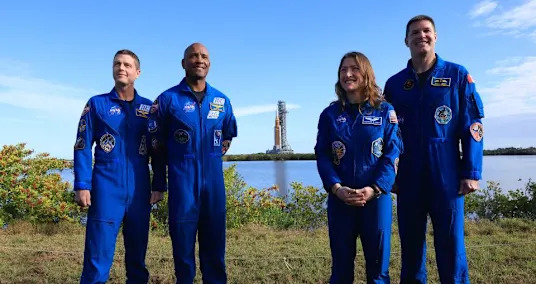
NASA's launch with four astronauts will begin a 10-day flight around the moon, marking the most ambitious U.S. space mission in decades and a major step toward returning humans to the lunar surface before China's first crewed landing.
(Reporting by Lucila Sigal; Writing by Cassandra Garrison; Editing by Bill Berkrot)
NEUESTE BEITRÄGE
- 1
 How a niche Catholic approach to infertility treatment became a new talking point for MAHA conservatives12.12.2025
 - 2Insurance warning signs in doctors’ offices might discourage patients from speaking openly about their health23.11.2025
- 3Why don’t humans have hair all over their bodies? A biologist explains our lack of fur31.12.2025
- 4Hidden Island Cameras Capture Rare Tasmanian Species for the First Time Ever07.04.2026
- 5Tech for Wellbeing: Applications and Devices for a Better You01.01.1




Ähnliche Artikel
- WATCH: IDF strikes, dismantles missile launchers in southern Lebanon31.03.2026
- IDF strikes Hamas terror base in Lebanon, Health Ministry says 11 killed18.11.2025
- NASA’s history-making moon mission aims to send the first woman and person of color to deep space27.03.2026
- Equality requires universal draft, participation in economy and workforce, MK Liberman says25.12.2025
- Senegal limits foreign trips for officials as the fallout from Iran war deepens04.04.2026
- Kobe Bryant called this WNBA star the 'Gold Mamba.' She turned his advice to her into a tattoo.02.12.2025
- Israel Police arrest twenty-one as anti-war protests grow despite broad support for Iran war30.03.2026
- Instructions to Arrange Your Compensation During Medical caretaker Prospective employee meetings17.10.2023
- Becoming amazing at Arranging Pay Raises22.09.2023
- Spain's Easter processions draw more tourists amid Iran war02.04.2026