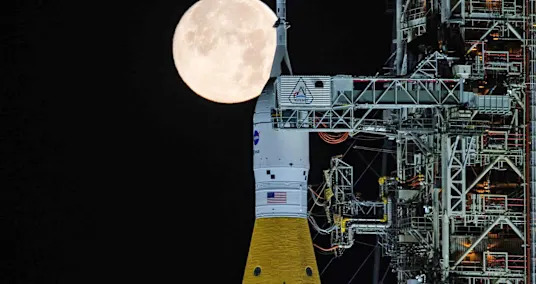
The countdown is on for the launch of NASA’s Artemis II mission around the moon.
At 6:24 p.m. ET Wednesday, four astronauts are scheduled to lift off from NASA’s Kennedy Space Center in Florida, beginning a 10-day journey that will take them looping around Earth and the moon.
The crew — NASA astronauts Reid Wiseman, Christina Koch and Victor Glover and Canadian astronaut Jeremy Hansen — will be the first people to launch toward the moon since the Apollo 17 mission in 1972, more than 50 years ago. They will not land on the lunar surface; rather, the mission is designed as a step toward a landing in 2028, and eventually, toward NASA’s goal of establishing a long-term presence on the moon.
“I think the nation and the world has been waiting a long time to do this again,” Wiseman said Friday after he and fellow crew members arrived at the Kennedy Space Center. “On behalf of myself, Victor, Christina, Jeremy, we are really pumped to go do this.”

The crew will be the first people that NASA’s giant Space Launch System moon rocket and Orion capsule carry into space. The agency previously tested the technology with an uncrewed mission around the moon, Artemis I, in 2022.
Mission managers plan to begin launch preparations Monday, powering up parts of the rocket and spacecraft. As the astronauts await launch day, they remain in quarantine to limit their exposure to germs.
If all goes smoothly, NASA will start to fill the booster early Wednesday with more than 700,000 gallons of cryogenic propellant. This loading process can take up to five hours, according to NASA. The astronauts will be driven to the launch pad roughly 4 hours and 40 minutes before liftoff, where crews will help strap them into their seats aboard the Orion capsule.

NASA plans to stream the launch live beginning at 12:50 p.m. ET on its YouTube channel, which will also offer live views from the Orion capsule during the mission.
Wiseman said the crew nicknamed their spacecraft “Integrity,” as a nod to the principle that guided them and their colleagues throughout their training.
“Integrity just fit everything,” he told NBC News in an interview in September. “You can be in integrity and you can be out of integrity. And so for us, as the first crew of Artemis, we strive every day to be in integrity.”
The astronauts wanted to convey a sense of unity and togetherness, so Glover said the crew members designed their mission patch to make “A II” — for “Artemis II” — styled to look like the word “All.”
“We want everybody to be a part of this mission,” he said. “There’s a lot of little things that will divide us. It’ll fill in the cracks and expand, if we let it. And it would be nice if this could just be some caulking, some reinforcement to fill in those spaces, to prevent division.”

Around 8½ minutes after they lift off, Wiseman, Koch, Glover and Hansen will be in space. The astronauts will spend the first day of the mission orbiting Earth and testing Orion's life-support systems, which help regulate temperature, air quality and other factors that keep the crew safe. That includes the spacecraft's drinking water, food and waste systems.
On the second day of the mission, the spacecraft’s main engines are expected to fire to put it on a path toward the moon.
While en route over the following four days, the astronauts are tasked with testing how well the Orion capsule protects against space radiation and demonstrating procedures for emergencies and other situations in anticipation of future Artemis missions. The next flight in the program, Artemis III, aims to conduct further technology demonstrations in low-Earth orbit — notably, docking in space with a second spacecraft that will carry astronauts to the lunar surface. After that, NASA plans to put astronauts on the moon on the Artemis IV mission in 2028.

Assuming they launch successfully Wednesday, the Artemis II crew is scheduled to circle the moon April 6, coming within about 6,000 miles of the lunar surface. As they swing around the moon, the astronauts could travel farther from Earth than humans ever have before, besting the Apollo 13 record of 248,655 miles set in 1970.
From the crew's vantage point aboard the Orion capsule, the moon will appear about the size of a basketball held at arm’s length, according to NASA. During their lunar flyby, the astronauts will become the first humans to see some parts of the moon up close and in person. NASA said the crew will spend most of the day taking photos and videos and recording observations.
The capsule should then spend the next several days journeying back to Earth, before splashing down in the Pacific Ocean off the coast of San Diego on April 10.

The NASA mission managers operating behind the scenes during Artemis II have been awaiting this launch for many years.
“This is something we’ve prepared for for a long time,” said Harper Cox, who oversees the astronauts’ intravehicular activities (what they’ll be doing daily inside Orion throughout the mission). “Leaving Earth orbit with humans again — first time in my lifetime — we’re all very, very excited.”
Artemis flight director Charlie Blackwell-Thompson said her moon ambitions started early, watching the last Apollo mission as a child.
“I can remember that curiosity, that intrigue,” she said. “And, you know, being a first grader, a second grader going out and looking up at the moon and just being struck with wonder ... And so when I think about young kids that maybe will get that same sensation, I think, ‘Wow.’”

As she prepares to count down to the Artemis II liftoff, Blackwell-Thompson said, the safety and well-being of the crew members will be top of mind.
“They’re our co-workers, they’re our friends, they’re are an extension of our family,” she said. “And it is our job as the launch control team to launch them safely. And we take that responsibility very seriously.”
This article was originally published on NBCNews.com
NEUESTE BEITRÄGE
- 1
 Figure out How to Function Successfully with Your Auto Collision Legal advisor for the Best Result19.10.2023
 - 2From Educational Loans to Obligation Free: Independence from the rat race Accomplished22.09.2023
- 3Are multiverses real? An astrophysicist explains why it depends on how you define ‘real’30.03.2026
- 4Ergonomic Office Seats for Work spaces06.06.2024
- 5Investigating Design and Individual Style: Track down Your Remarkable Look06.06.2024





Ähnliche Artikel
- Figure out How to Adjust Your Handshake to Various Societies19.10.2023
- American Airlines Flight Attendant Disappears Amid Layover in Colombia, Authorities Investigating26.03.2026
- Becoming amazing at Arranging Pay Raises22.09.2023
- Federal judge upholds Hawaii's new climate change tax on cruise passengers24.12.2025
- The wolf supermoon will kick off 2026 with a celestial bang. Here's when and how to see it.30.12.2025
- The Best Web-based Courses for Ability Advancement07.07.2023
- Christmas 2025 skywatching guide: What you can see in the night sky on Dec. 2525.12.2025
- Extreme Manual for Picking a Camper Van05.06.2024
- Space station changes command, setting stage for Crew 11 departure12.01.2026
- Boeing's troubled capsule won't carry astronauts on next space station flight24.11.2025