Moscow has labelled Germany's international broadcaster Deutsche Welle (DW) an "undesirable organization," effectively banning its activities in the country.
The move follows a recommendation by the State Duma, Russia's lower house of parliament, DW reported on Sunday.
A government statement posted on Telegram on Saturday said the General Prosecutor's Office now considers DW to be "at the forefront of hostile anti-Russian propaganda." The prosecutor's office has not issued a separate statement.
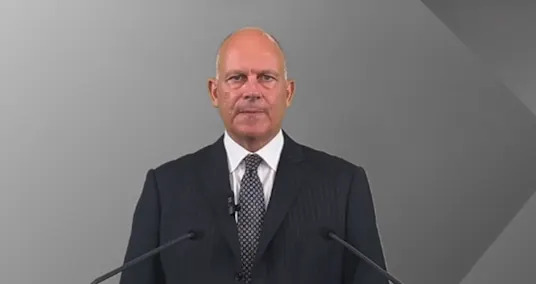
DW Director General Barbara Massing criticized the tightening of the crackdown on free media by the Russian judiciary.
"Russia may label us an undesirable organization, but that won't deter us. This latest attempt to silence free media highlights the Russian regime's blatant disregard for press freedom and exposes its fear of independent information," Massing said in a statement.
"Despite censorship and blocking of our services by the Russian government, DW's Russian-language service now reaches more people than ever before.
"We will continue to report independently – on the war of aggression against Ukraine and other topics about which little information is available in Russia. So that people can form their own opinions," Massing said.
Russia has targeted DW for years, revoking accreditations and banning its broadcasts in February 2022. The broadcaster's website has been blocked, and DW was labelled a "foreign agent" in March 2022.
The new designation further tightens restrictions, as cooperation with an "undesirable organization" can lead to fines or prison sentences.
"This means that Russian employees of DW are particularly affected," Massing added.
Russian lawmaker Vasily Piskaryov said that cooperation with DW would now be punished as a violation of the law. He is chairman of the State Duma commission that investigates alleged foreign interference in Russia's internal affairs.
DW has yet to receive formal notification from the General Prosecutor's Office, Massing said. However, there are measures to circumvent censorship in order to continue to reach Russians in their home country.
In addition to the media, the Russian judiciary has also classified non-governmental organizations and foundations as "undesirable." The list of those affected is getting longer and longer.
Kremlin spokesman Dmitry Peskov once described the censorship measures in Russia as unprecedented and justified them as necessary in view of the "information war" accompanying Moscow's invasion of Ukraine.
NEUESTE BEITRÄGE
- 1
 Taylor Swift changes 2 song lyrics on 'Reputation' on the night of her Eras tour documentary premiere12.12.2025
 - 2Instructions to Pick the Right Toothbrush for Your Teeth19.10.2023
- 3Earthquake in Indonesia kills at least 1 person and sets off small tsunami01.04.2026
- 4A decade after Brazil’s deadly dam collapse, Indigenous peoples demand justice on the eve of COP3005.11.2025
- 5Fake new headlights rule steer Australian drivers astray12.11.2025





Ähnliche Artikel
- Netanyahu on Gush Etzion terror attack: 'We will complete war on all fronts'18.11.2025
- Air India chief resigns 10 months after devastating Ahmedabad crash and amid mounting financial troubles07.04.2026
- Golan resident convicted of spying for Iran after passing tank movement, missile-impact data26.03.2026
- Instructions to Figure out the Various Phases of Cellular breakdown in the lungs17.10.2023
- Trial of pro-Palestine activist begins27.11.2025
- NASA loses contact with its Maven spacecraft orbiting Mars for the past decade10.12.2025
- Arrow Exploration brings new Colombian oil well on stream ahead of schedule and under budget01.04.2026
- NASA astronauts take new moonsuit for a swim | Space photo of the day for Nov. 28, 202528.11.2025
- Death toll from floods in Afghanistan rises to 6104.04.2026
- Watch SpaceX launch 119 payloads to orbit from California early on March 3029.03.2026